Business & Organizations
If you hover over the cover, you will see the title of the book. Clicking on the cover of the book will take you to the book’s Amazon page for further information or purchase.
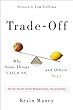
What Jeremiah Says: In Trade-Off, Kevin Maney thoroughly explains the successes and failures of businesses who have took aim at what he calls, “the fidelity mirage.” This ‘fidelity mirage,’ is when a company believes that they can create a product (or service) that is simultaneously of high fidelity and of high convenience. Maney defines fidelity as “the total experience of something.” Another way of looking at fidelity is quality. The higher the quality of experience, the higher the fidelity. Overall, Trade-Off is an essential book for anyone looking to gain a better understanding of why some products or services succeed and others don’t. More importantly, for those aspiring entrepreneurs out there, Maney illustrates, by example, some sure-fire ways for your product to NOT make it off the ground. His advice is sound and based on years of experience.


What Jeremiah Says: I really enjoyed reading all of Malcolm Gladwell’s books. In The Tipping Point, he offers a sociological perspective on epidemics. In Blink, he describes how the brain makes split-second decisions – sometimes to our detriment – and sometimes to our benefit. In Outliers, maybe my favo[u]rite of all his books, he talks about the qualities of people who have high levels of success. In What the Dog Saw, he has compiled a collection of his writings for The New Yorker.
What Jeremiah Says: Timothy Ferriss is the ultimate guru for anyone interested in entrepreneurship, working as little as possible, and enjoying it! He has basically written a guide to slowly wean you off of working 9-5 at a dead-end job you don’t relish. He gives you tangible ways to transition into a more balanced life of retirement/work such that instead of saving your retirement for when you’re 65, you can ‘retire’ right now and spend half your time working and half your time ‘vacationing.’ If you’re the kind of person that likes to hear how other people have done it before you jump in, then the 2nd edition is for you as Ferriss updated his original version and included all sorts of testimonials from people who have put to use the wisdom he has offered.
What Jeremiah Says: Sanaya Roman and Duane Packer do an absolutely wonderful job of approaching the idea of abundance from a spiritual perspective. You could almost call this a workbook as Creating Money has tangible steps for the reader to take in order to
increase their abundance. To be clear, this is not a how-to book like Cash in a Flash. Creating Money is more directed at changing the psychological perspective we have of money and to money – a very important part about making money. Pairing this book with Cash in a Flash or The 4-Hour Workweek are highly recommended.

What Jeremiah Says: Mike Dooley and his Notes from the Universe are just wonderful. He has made his notes from the universe into three books and you can also subscribe to them daily. In his two books ‘not’ specifically about Notes from the Universe, Dooley gives the reader a road-map for creating the kind of life they want in a number of ways. My favo[u]rite suggestion comes from Infinite Possibilities, where Dooley suggests that the reader have a “lunch meeting” with a friend of theirs and act as if it is 5 years from now and the things that they’ve wanted to have happen in that timespan has already occurred. There are lots of little goodies like that to be found in both of Dooley’s books.
What Jeremiah Says: Mark Victor Hansen and Robert G. Allen
have written a masterpiece of sorts when it comes to making money as quickly as possible. There are lots of books on the shelves of bookstores with ‘recipes’ for how-to make a lot of money really quickly, but I’ve rarely come across a book like Cash in a Flash where the authors are sure to incorporate the spiritual aspects (without calling them that) to ensure that the reader is truly able to reach financial abundance. The beauty of this book is not only is there a very logical and linear spelled out way to do it, but they’ve also written a fictional story for those who would rather learn from a parable of sorts.
